
Broadband and wide-temperature dissipation continuum in a supramolecular damping orgwnohydrogel...
Citation
Ning Zhou, Sen Liu, Zhouyue Lei* and Peiyi Wu*. Broadband and wide-temperature dissipation continuum in a supramolecular damping organohydrogel for motion-tolerant bioelectronics. Nat. Commun. 2026, 17, 9852.
Abstract
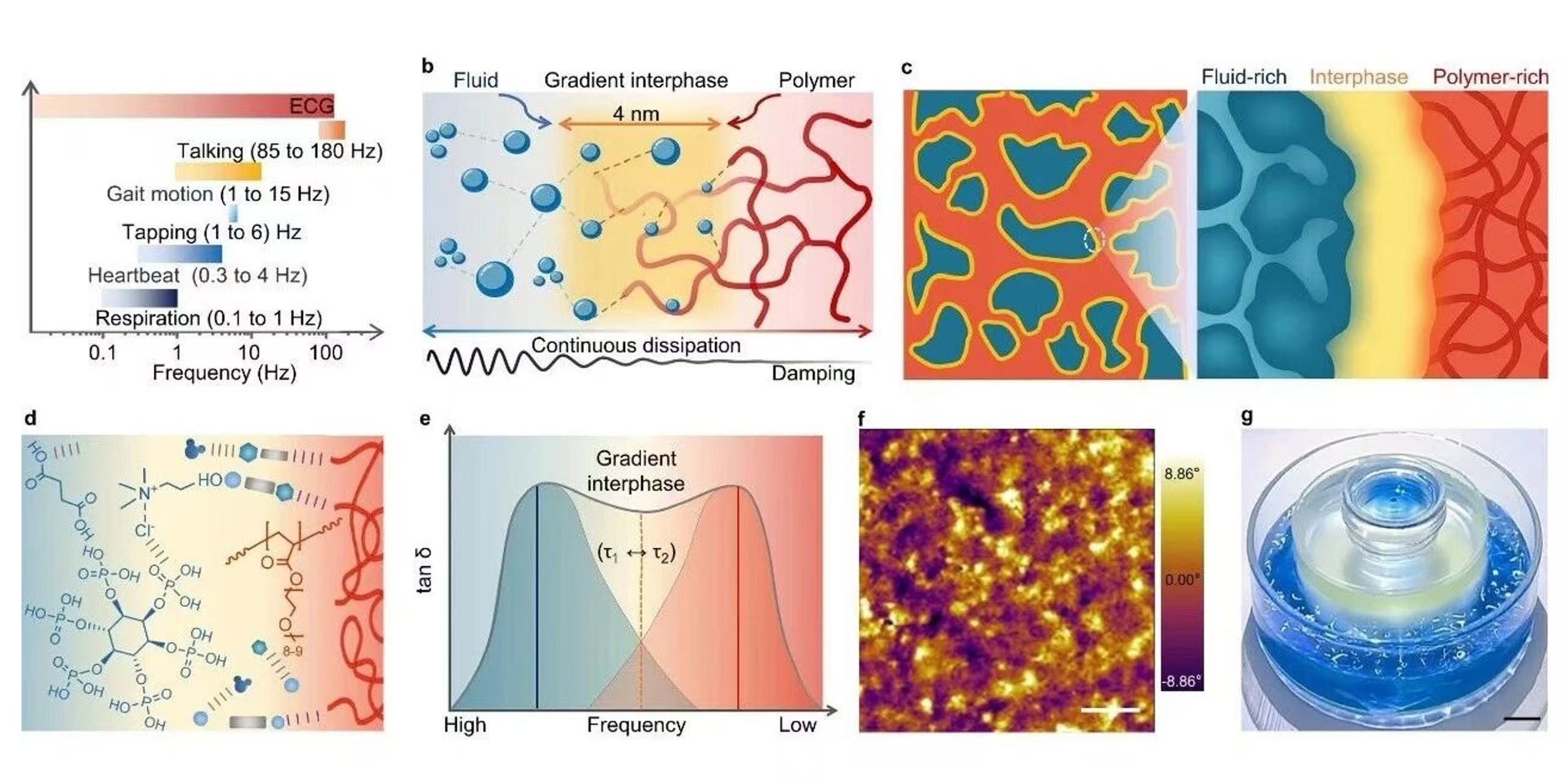
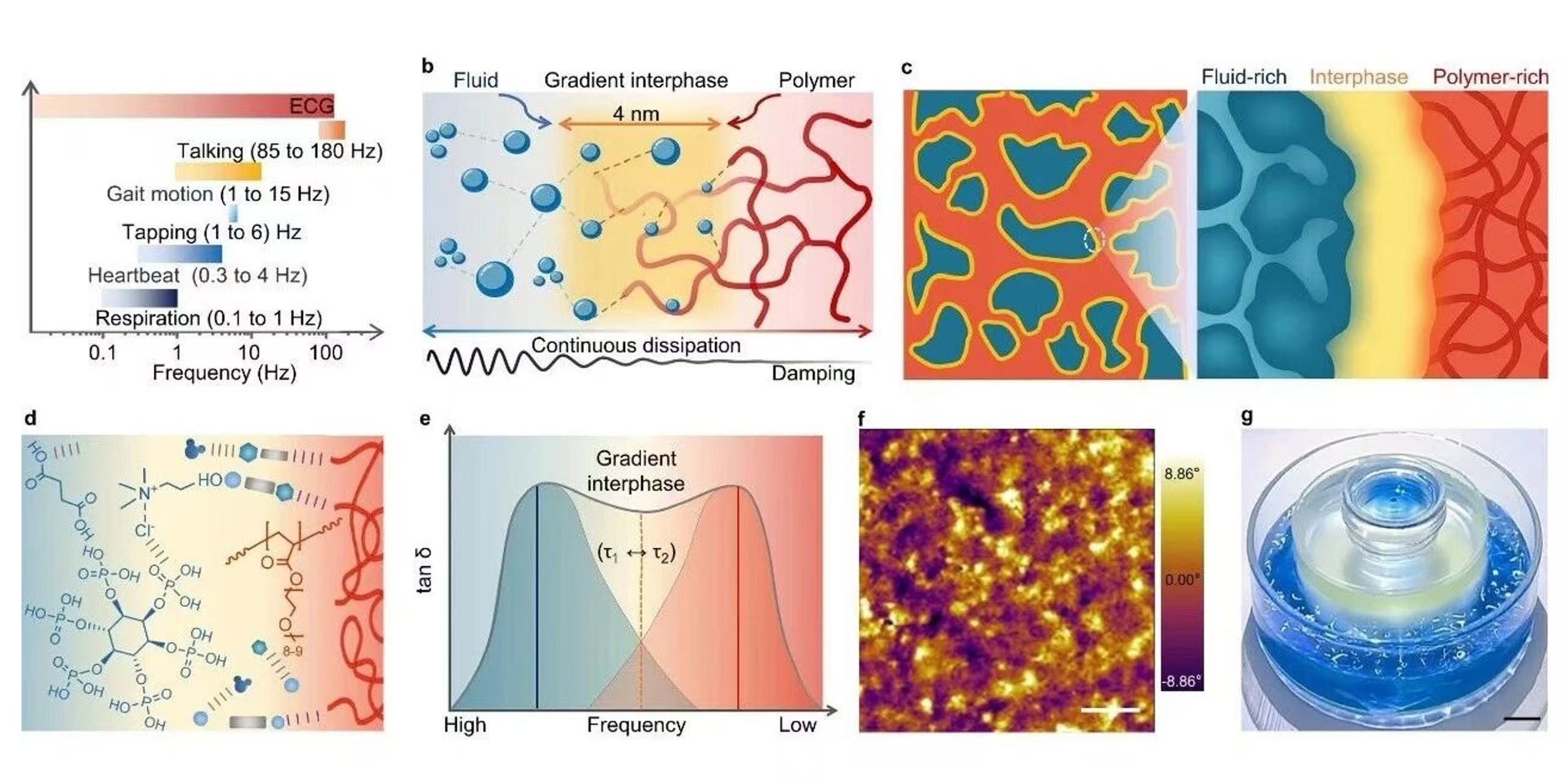
High-fidelity signal acquisition is the cornerstone of personalized healthcare, but wearable bioelectronics remain vulnerable to motion artifacts, which contaminate the electrophysiological signals. Conventional materials rely on discrete viscoelastic relaxation mechanisms, resulting in narrow damping bandwidths and high thermal sensitivity that fail to match the continuous, broadband nature of mechanical noise. Here, we address these limitations by engineering a dissipation continuum within a supramolecular organohydrogel. By constructing a gradient layer with nanoscale confinement at the phase boundary between the fluid and the polymer, it couples the fast viscous flow of the confined fluid with the slow segmental dynamics of the polymer network. Acting as a dynamic bridge, it expands an isolated relaxation into a continuous temporal relaxation spectrum, ensuring that the multiscale dissipation of the mechanical energy enters the dynamic network. Consequently, the material achieves a high damping factor (tan δ ≥ 0.8) across a wide temperature window (−30 to 100 oC) and a broad frequency spectrum (0.5-200 Hz). Functioning as an intrinsic broadband noise-filtering interface, it enables artifact-free electrocardiogram recordings under mechanical disturbances. By shifting noise mitigation from post-processing electronics to proactive material design, our work establishes a robust materials foundation for motion-tolerant bioelectronics operating in mechanically complex environments.